Showing posts with label Christianism. Show all posts

Sunday, July 5, 2020

4th of July and American Religious Nationalism

Is the US a Christian nation? Does embracing Christian nationalism part of being a Christian in America? Is the 4th of July a Holy Day?

Angela Denker is a Lutheran pastor in her article "Christian nationalism, the border and Fourth of July church in Dallas" critiques the close link of American nationalism and Christianity. She visits a megachurch on the 4th of July and informs how the 4th of July has become a religious holiday as are many other national holidays in America. How America is worshiped almost as an idol in many churches: 

When I got there for Saturday night worship, I found out that Prestonwood had a big Fourth of July celebration planned for Independence Day. Pastor Jack Graham promised at the beginning of Saturday worship that they’d be “celebrating our freedoms as a country ... and singing patriotic songs,” as well as offering a pastor dunk tank, games and refreshments in the Dallas summer heat.

When I walked in, I noticed that the arena-style worship space that seats 7,000 had been covered with red, white and blue American flag bunting. Flags festooned the stage, and most of the screen designs and backgrounds were red, white, and blue.

As Graham concluded his welcome for the evening service, he said, “We’re going to start with the Pledge of Allegiance, the national anthem and honoring our service members.”

I had not said the Pledge of Allegiance since elementary school, and I could not help but think of the Ten Commandments — ostensibly as influential here as the pledge. The First Commandment, as found in the Book of Exodus, warns against worshipping and pledging allegiance to a flag and not to God, but no one around me seemed to mind, so, feeling a compulsion to conform, I put my hand on my heart and mouthed the words.

We then sang “The Star-Spangled Banner” and sat as the songs for each branch of the armed forces played, and veterans and active-duty soldiers were invited to stand when their branch was called, and we applauded.

The idea of American exceptionalism having a biblical justification is not new, but Prestonwood made it fresh. The church had bright and compelling red, white and blue graphics with retro black-and-white photography, a guest preacher who specializes in travel to the Middle East, and even a special song. The video montage and song came next, followed by the guest speaker. 

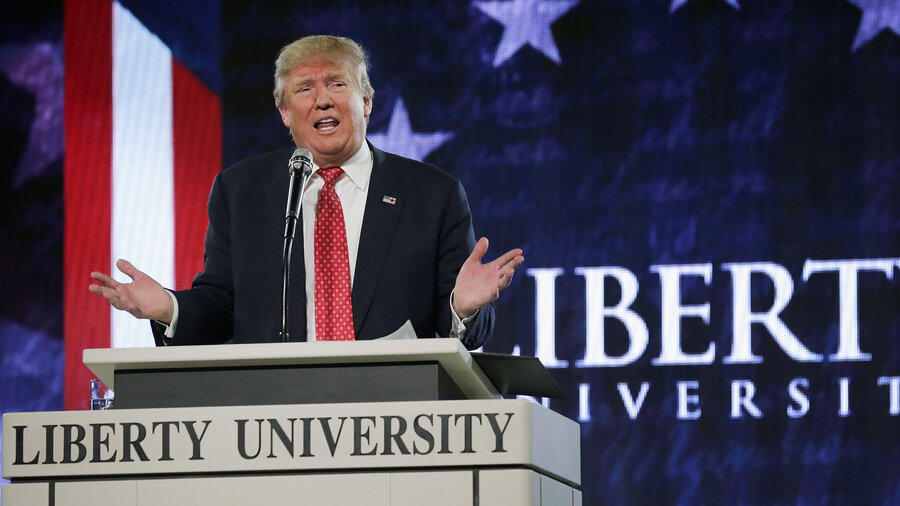
Pastor Denker contrasts this deep entanglement of Christianity and the American state with another view where love of Christ and love for America are at war. She writes about her conversation with Dean Inserra, a prominent conservative evangelical pastor. He is a Liberty University graduate and the founder of City Church in Tallahassee, Florida. He is also an advisory member of the Ethics and Religious Liberty Commission of the Southern Baptist Convention.

Inserra told me about a term from Southern Baptist theology that describes the current moment in American politics and religion. “In this linking of nationalism and Christianity, we are forgetting about the message of Jesus. ... When we do that, we have a gospel distortion.”

A gospel distortion is the idea that another ideal is impeding the truth of the gospel. Inserra said the gospel distortion in the SBC during and before Trump’s presidency has its roots in Christian nationalism.

“We have to be Christian first. If you are American first, Jesus will be at odds with you,” he said. “Patriotism is not a fruit of the Spirit. It’s idolatry on the Fourth of July.”

Inserra pointed to national holidays that receive as much attention in the SBC as Christmas and Easter. “I say there are different high holy days in the Southern Baptist Church. Some churches have Pentecost and Epiphany. We have the Fourth of July, the Sunday closest to Veterans Day, the Sunday closest to Sept. 11. You go to a Southern Baptist Church on the Fourth of July, you’d think you were at a baseball game, eating a hot dog.”
Ira Stoll, a conservative editor and columnist, argued in his essay, The Theology of the Fourth of July, in Time magazine, that 4th of July is a religious holiday and it was the liberal icon President Kennedy who told us that. Ira quotes three different speeches, including his inaugural address, to prove his point. 
For instance, on July 4, 1946, Kennedy was invited to speak at the City of Boston’s Independence Day celebrations. 
Kennedy began by talking not about taxes, or about the British, or about the consent of the governed, but about religion. “The informing spirit of the American character has always been a deep religious sense. Throughout the years, down to the present, a devotion to fundamental religious principles has characterized American though and action,” he said

Ira contends that even if we ignore Kennedy, there is enough evidence from the founding documents and the founding fathers of America about the nature of the state that was imagined in the early years:
Whatever Kennedy’s motives were as a politician for emphasizing this point, on the historical substance he had it absolutely correct. The Declaration of Independence issued from Philadelphia on July 4, 1776, included four separate references to God. In addition to the “endowed by their Creator” line mentioned by JFK in his July 4 speech, there is an opening salute to “the laws of nature’s God,” an appeal to “the Supreme Judge of the World,” and a closing expression of “firm reliance on the protection of divine Providence.”

A signer of the declaration, Samuel Adams, writing to a friend on July 9, wished the declaration had been issued earlier: “If it had been done nine months ago we might have been justified in the sight of God.”

George Washington, announcing the Declaration of Independence to the troops in a General Order dated July 9, wrote, “The General hopes and trusts, that every officer and man, will endeavour to live, and act, as becomes a Christian Soldier defending the dearest Rights and Liberties of his country….knowing that now the peace and safety of his Country depends (under God) solely on the success of our arms.”
Ira ends his essay by saying that Americans can believe whatever they like but "the idea on which our nation was founded" was clearly religious.

Tuesday, December 6, 2016

Make America White and Christian Again

Mirren Gidda of Newsweek, like many others, tried to answer the question, 'How did Trump win?' The answer might come as a shock; many Americans, living in one of the most secular and diverse countries, want to make America a white, Christian country.

There were many things going against Trump and the prospect of him winning the US presidency was so farfetched that it was considered funny. He had no political or military experience and the twice-divorced billionaire, who had lived an irreligious life, was vying to get the nomination of the Republican Party which is largely dependent on evangelicals for its recent successes. Furthermore, non-White and women voters made a majority of the American electorate and Trump managed to keep offending these two groups during the whole campaign. Finally, he had little grasp of the complex political and economic issues that America, and the world, faced and his ignorance was exposed.

But still Donald Trump won and he did not win by attracting the poor, most of whom voted for Clinton:
Trump voters tended to be older (53 percent of people aged 45 and over voted for him), well-off and white. According to the exit polls, 58 percent of all white voters chose Trump at the voting booth, while just 21 percent of non-white voters cast their ballots for the Republican nominee.
The biggest issue for Trump voters—ahead of foreign policy, the economy or terrorism—was immigration, exit polls showed, with 84 percent of Trump voters saying that the government should deport undocumented migrants rather than give them the chance to apply for legal status.
Analysts say Trump’s success among white voters is partly attributable to his tapping into concerns about immigration and a feeling among many voters that the U.S. should be a white, Christian country. “It’s like everything he said hit the right nationalistic buttons,” says Allyson Shortle, assistant professor of political science at the University of Oklahoma...
According to Shortle, research shows that religious nationalism features particularly heavily among Trump’s supporters. It is part of the reason, she says, that Trump’s proposed ban on Muslims entering the U.S. played so well. It appealed to “this narrow vision of a Christian America,” Shortle says.

Trump's attraction was thus partly religious and partly racial. Two of his signature policies were building a wall to put an end to immigration from Mexico and denying Muslims entry into the US. Scholars argue that Trump tapped into white, Christian nationalism that many Americans believe in, although few would openly say so:
“Some people think about it as an ideology, a movement, or an attitude—but some research, including my own, views nationalism as part of a person’s social identity,” writes Kathleen Powers, assistant professor in the department of international affairs at the University of Georgia, in an email to Newsweek . “When people identify with a nationality, they have an idea about what defines the prototypical or archetypal group member. In short, they carry a picture of what it means to be an American.
“That prototypical American,” Powers adds, “might be defined in relatively inclusive terms, like a person who respects political institutions, or in more exclusive terms, like someone who is part of a Judeo-Christian religion, speaks English, or is a member of a certain racial group. Certainly, some people define the prototypical American as white, Christian, and/or born in the U.S.”
And if that’s your conception of what it is to be an American, Powers writes, then anyone who deviates from the norm is either not a true American, or is a poor version of one.
What figures prominently in how ordinary citizens define what it is to be an American, Shortle says, is the notion of the U.S. and its peoples as a Christian nation. (The Pilgrim Fathers, who founded what came to be the United States of America, were Christian dissenters fleeing religious persecution in Europe.)
Even today, religious nationalism remains strong among a significant proportion of U.S. citizens. On September 29, a poll of 4,000 Americans—which Shortle helped organize—found that 43 percent of respondents thought that the abundant natural resources in the U.S. were a sign that God wanted America to lead the rest of the world. Sixty percent of those surveyed believed that the U.S. holds a special place in God’s plan. (Not all of the people polled were Christian or even religious).

Obama's two-term presidency would certainly make you fearful of the catastrophic times ahead. The son of a black Muslim becoming President of the Republic could have been the last straw. 

Image result for trump evangelicals

Professor Gorski, one of the most preeminent scholars of nationalism, agrees but claims that Trumpism is a secular religious nationalism (it seems like an oxymoron but let's read Professor Gorski):

There are various interpretations of Trumpism on offer. Reading it as fascism explains its appeal to the white nationalists of the “alt-right.” Reading it as populism explains its appeal to a white working class fed up with the “Washington establishment.” And reading it as authoritarianism explains its appeal to voters with authoritarian personalities. These interpretations are not necessarily wrong, but they do not explain Trump’s appeal to evangelicals qua evangelicals.
So, let me propose a different interpretation. On this reading, Trumpism is a secular form of religious nationalism. By “religious nationalism,” I mean a form of nationalism that makes religious identity the litmus test of national belonging. By “a secular form of religious nationalism,” I mean one that strips religious identity of its ethical content and transcendental reference. In Trumpism, religion functions mainly as a marker of ethnicity.

Gorski argues that devoid of any ethical dimension, bloody conquest and violent apocalypse, has been the basic recipe for this secular religious nationalism, which is also referred by its more innocuous-sounding name 'American Exceptionalism.' Trump does not use the religious rhetoric like many other US Presidents but the idea is similar:

Trump does not allude to the Tribulation or the Second Coming in the way that old school religious nationalists like Jerry Falwell or Pat Robertson did. But Trump does portray the contemporary world as an apocalyptic hellscape. There are no demons or angels, no monsters or dragons. Just “real Americans” threatened by hordes of Syrian refugees, gangs of Muslim terrorists, and swarms of Mexican rapists. Trump’s apocalypse is a secular one.
With Christ out of the picture, the role of Messiah is open again. He claims that he and he alone has the power to cast these monstrous minions back into their respective pits, as long as his followers put their faith in him. “Believe me folks,” he often says, “I will do it.” I will deliver you from evil, I will redeem you from poverty, and I will lift you up again above all races. American will “win” again. In Trumpism, the Second Coming of Christ becomes the First Term of the Donald.
Gorski argues that it's Christianism, not Christianity (perhaps similar to what Islam is to Islamism) and that's why it is not the most pious, but the most political, Christians that are attracted to Trump:

Reading Trumpism as a secular version of religious nationalism not only explains why so many evangelicals rallied to Trump, it also sheds light on which evangelicals did so. Not the more pious of the evangelical masses, as it turns out, nor the more theologically astute of its leaders. During the spring of 2016, opinion polls turned up a fascinating finding: an inverse relationship between church attendance and support for Trump. As for Graham Jr. and Falwell Jr., they are political leaders, not thought leaders.
In short, the affinity is not really between Trump and Christianity—it’s between Trumpism and Christianism. By Christianism, I mean Christianity as a political identity denuded of ethical content. Trumpism is a Christianist version of political theology.
Professor Gorski's explanation is interesting but I would like to ask if Trump did not act like a Christian and did not talk like a Christian then how can we accuse him of being a (secular) religious nationalist. Many political leaders claim that they will bring heaven on earth and without them there would be apocalyptic hellscape so are all of them religious nationalists, even if they persecute religious nationalists and abhor religion? If this is so, almost every political leader, atleast in the developing world, is either a religious nationalist or a secular religious nationalist.

Is Christian nationalism increasing in America? According to a West Virginia University study reported in Huffpost, Christian nationalism was decreasing in America in 2014:

In their study, Whitehead and researcher Christopher Scheitle of West Virginia University analyzed more than 3,000 responses to questions on the qualities of being an American and patriotism from the 1996, 2004 and 2014 waves of the General Social Survey.
They presented their findings at the recent joint annual meeting of the Society for the Scientific Study of Religion and Religious Research Association in Atlanta.
Consider how the ties between religion and nationalism can change dramatically in different time periods:
  • In 1996, some 38 percent of respondents said being a Christian was very important to being an American. 
  • In 2004, just three years after the terrorist attacks of 9-11 and a year after the invasion of Iraq, nearly half, or 48 percent, of Americans, attributed the same significance to being a Christian. 
  • In 2014, a period of relative calm, the percentage dropped to one-third.


So, what happened in 2016? How did a liberal America vote for a person who denigrated women and racial/religious minorities during the whole election campaign? Is Christian nationalism still declining or it increased after 2014? Did fear of the ISIS, home-grown/lone-wolf terrorism and migration again linked Christianity with nationalism?