Showing posts with label Christianity. Show all posts

Monday, December 29, 2025

PRRI survey of Christian nationalism in the US

The Public Religion Research Institute (PRRI), an American nonprofit, nonpartisan research and education organization, conducts research on politics, culture, and religion. In 2024, PRRI conducted a pioneering national survey enabling estimates of Christian nationalism (CN) support across every U.S. state. Building on this effort, PRRI conducted in-depth interviews with over 22,000 adults to gauge the prevalence and drivers of these views. The following are some of their findings.


Three in ten Americans can qualify as Christian nationalists (10% CN adherents and 20% CN sympathizers). A similar percentage (29%) are rejectors of CN, while 37% were CN skeptics. Support for CN correlates strongly with politics, media consumption, age, and education. Most Republicans are Christian nationalists (53%), compared to only 22% of independents and 16% of Democrats. Americans who view far-right TV news, older Americans, and less-educated Americans also show majority support for CN. In terms of Christian denominations, White evangelical Christians and Hispanic Protestants are the groups most likely to support CN. Also, frequent church attendees (51%) are far more CN supportive than those who seldom or never attend (18%). 

Geographically, unsurprisingly, support for CN is concentrated in the US South and Midwest. States, where CN has the highest support (approximately 50% of their residents) include Mississippi, Oklahoma, Louisiana, Arkansas, West Virginia, and North Dakota. Regarding elections and democracy, most Christian nationalists (two-thirds of adherents and nearly half of sympathizers) believe Trump’s victory was divinely ordained. They also express greater confidence in democracy’s strength, are more likely to believe Trump will leave office peacefully, and are less concerned he will use federal power to punish opponents.

Christian Nationalist Americans differ from other Americans on immigration and gender roles. A large majority of CN believe immigrants are mostly illegal, are invading the US, and are replacing their culture and ethnicity. They are also more likely to believe society has become too soft and feminine and that men and women should stick to “naturally suited” roles. Finally, believers in CN are more inclined to endorse political violence.


Sunday, July 5, 2020

4th of July and American Religious Nationalism

Is the US a Christian nation? Does embracing Christian nationalism part of being a Christian in America? Is the 4th of July a Holy Day?

Angela Denker is a Lutheran pastor in her article "Christian nationalism, the border and Fourth of July church in Dallas" critiques the close link of American nationalism and Christianity. She visits a megachurch on the 4th of July and informs how the 4th of July has become a religious holiday as are many other national holidays in America. How America is worshiped almost as an idol in many churches: 

When I got there for Saturday night worship, I found out that Prestonwood had a big Fourth of July celebration planned for Independence Day. Pastor Jack Graham promised at the beginning of Saturday worship that they’d be “celebrating our freedoms as a country ... and singing patriotic songs,” as well as offering a pastor dunk tank, games and refreshments in the Dallas summer heat.

When I walked in, I noticed that the arena-style worship space that seats 7,000 had been covered with red, white and blue American flag bunting. Flags festooned the stage, and most of the screen designs and backgrounds were red, white, and blue.

As Graham concluded his welcome for the evening service, he said, “We’re going to start with the Pledge of Allegiance, the national anthem and honoring our service members.”

I had not said the Pledge of Allegiance since elementary school, and I could not help but think of the Ten Commandments — ostensibly as influential here as the pledge. The First Commandment, as found in the Book of Exodus, warns against worshipping and pledging allegiance to a flag and not to God, but no one around me seemed to mind, so, feeling a compulsion to conform, I put my hand on my heart and mouthed the words.

We then sang “The Star-Spangled Banner” and sat as the songs for each branch of the armed forces played, and veterans and active-duty soldiers were invited to stand when their branch was called, and we applauded.

The idea of American exceptionalism having a biblical justification is not new, but Prestonwood made it fresh. The church had bright and compelling red, white and blue graphics with retro black-and-white photography, a guest preacher who specializes in travel to the Middle East, and even a special song. The video montage and song came next, followed by the guest speaker. 

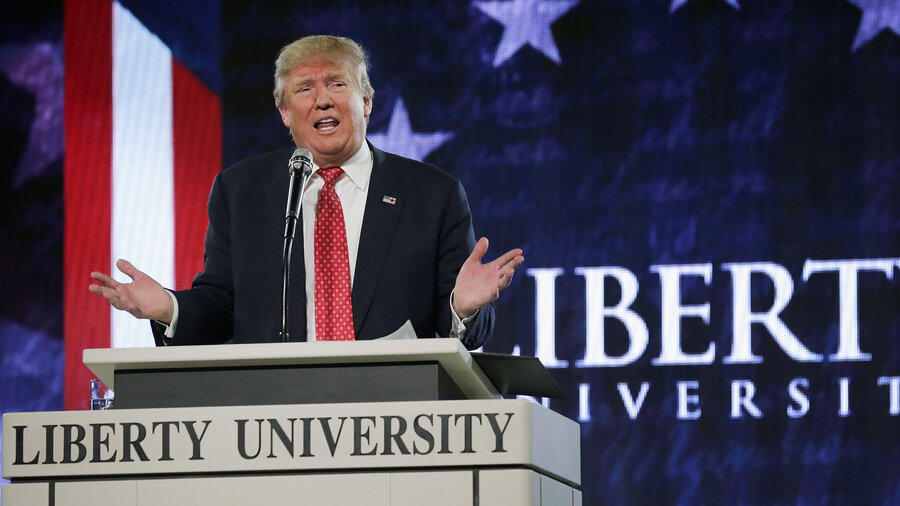
Pastor Denker contrasts this deep entanglement of Christianity and the American state with another view where love of Christ and love for America are at war. She writes about her conversation with Dean Inserra, a prominent conservative evangelical pastor. He is a Liberty University graduate and the founder of City Church in Tallahassee, Florida. He is also an advisory member of the Ethics and Religious Liberty Commission of the Southern Baptist Convention.

Inserra told me about a term from Southern Baptist theology that describes the current moment in American politics and religion. “In this linking of nationalism and Christianity, we are forgetting about the message of Jesus. ... When we do that, we have a gospel distortion.”

A gospel distortion is the idea that another ideal is impeding the truth of the gospel. Inserra said the gospel distortion in the SBC during and before Trump’s presidency has its roots in Christian nationalism.

“We have to be Christian first. If you are American first, Jesus will be at odds with you,” he said. “Patriotism is not a fruit of the Spirit. It’s idolatry on the Fourth of July.”

Inserra pointed to national holidays that receive as much attention in the SBC as Christmas and Easter. “I say there are different high holy days in the Southern Baptist Church. Some churches have Pentecost and Epiphany. We have the Fourth of July, the Sunday closest to Veterans Day, the Sunday closest to Sept. 11. You go to a Southern Baptist Church on the Fourth of July, you’d think you were at a baseball game, eating a hot dog.”
Ira Stoll, a conservative editor and columnist, argued in his essay, The Theology of the Fourth of July, in Time magazine, that 4th of July is a religious holiday and it was the liberal icon President Kennedy who told us that. Ira quotes three different speeches, including his inaugural address, to prove his point. 
For instance, on July 4, 1946, Kennedy was invited to speak at the City of Boston’s Independence Day celebrations. 
Kennedy began by talking not about taxes, or about the British, or about the consent of the governed, but about religion. “The informing spirit of the American character has always been a deep religious sense. Throughout the years, down to the present, a devotion to fundamental religious principles has characterized American though and action,” he said

Ira contends that even if we ignore Kennedy, there is enough evidence from the founding documents and the founding fathers of America about the nature of the state that was imagined in the early years:
Whatever Kennedy’s motives were as a politician for emphasizing this point, on the historical substance he had it absolutely correct. The Declaration of Independence issued from Philadelphia on July 4, 1776, included four separate references to God. In addition to the “endowed by their Creator” line mentioned by JFK in his July 4 speech, there is an opening salute to “the laws of nature’s God,” an appeal to “the Supreme Judge of the World,” and a closing expression of “firm reliance on the protection of divine Providence.”

A signer of the declaration, Samuel Adams, writing to a friend on July 9, wished the declaration had been issued earlier: “If it had been done nine months ago we might have been justified in the sight of God.”

George Washington, announcing the Declaration of Independence to the troops in a General Order dated July 9, wrote, “The General hopes and trusts, that every officer and man, will endeavour to live, and act, as becomes a Christian Soldier defending the dearest Rights and Liberties of his country….knowing that now the peace and safety of his Country depends (under God) solely on the success of our arms.”
Ira ends his essay by saying that Americans can believe whatever they like but "the idea on which our nation was founded" was clearly religious.

Tuesday, June 30, 2020

Is there a separation of church and state in Islam?

Millions of people, both Muslims and non-Muslims, even scores of academics, believe that in Islam, there is no separation of church and state. They point out to Prophet Muhammad (PBUH) being a prophet as well as the head of the state. The period of the first four righteous caliphs, the Rashidun (632-661), is also presented as evidence.  The presence of close links between Muslim kings and ulema (scholars of Islam) and the implementation of Sharia by Muslim sovereigns strengthens the case and finally, views of noted Islamists and examples of governments of Iran and Saudi Arabia are used to close the argument.

Several assumptions are made in these arguments that have no basis in history. These assumptions are based on applying a normative framework based on European experience on Islam. Understanding Islamic religion and history using European and Christian experience as the model will, unsurprisingly, lead to distorted and/or sub-optimal results. Following is an example of Muslims and Islam being considered copies of Christians and Christianity and Christian history of Europe being considered a model for Muslims to adopt:

Consider the most famous waves of Christian violence, in the 16th and 17th centuries. Wars of religion devastated Europe, killing huge percentages of national populations. States disintegrated and acts of terror were commonplace. The main impetus for these wars was the question of which Christian sect - Protestantism or Catholicism - would rule each state. Clergy had great amounts of political power, dispensing law and owning huge tracts of land. Nationalism was, as yet, weak. The question of which religion would dominate in which area was also the question of who would rule. 

Eventually Europe’s religious wars calmed down, and a solution was reached. In the Peace of Westphalia, it was agreed that governments - not clergy - would get to decide which religion would prevail in their territories...

Nowadays, the Middle East is embroiled in a set of conflicts that look a bit reminiscent of the European Wars of Religion. A few powerful, cohesive states - Iran, Saudi Arabia, and Turkey - are fueling proxy wars in anarchic areas like Iraq, Syria, Pakistan, Afghanistan, Somalia, Libya, and Yemen...Just as the European Wars of Religion featured Christians mostly killing Christians, the Islamic Wars of Religion feature mostly Muslims killing other Muslims...The obvious solution, it would seem, is for Islam to come to the same collective realization that Christianity came to after 1648 - that church and state make for a volatile mix, and should be separated. (Source: Noah Smith: Islam Needs To Separate Church and State)
The antagonistic relationship that Christianity had with the state for its initial three hundred years has no parallel in Islam, whose relationship with the state was without serious disagreements. Furthermore, and more importantly, there has never been a church in the form of the Catholic Church in Islamic history. One can search far and wide and will not find it. There has never been a pope, with his bishops, in Islamic history that could speak for God. In medieval Europe, there was one Pope (except for a few decades) and many rulers, making the Pope's opinion and approval important. In almost all Muslim realms, in contrast, there was one king and scores of Muslim scholars to choose from. There were many kings who may have been excommunicated by Muslim clerics but since there was no central religious authority so there were few repercussions for the king (excommunicating clerics, however, suffered imprisonment, exile, and even execution for their transgression). Kings and emperors always had many more clerics to endorse them than those who reject them.    


Graham E. Fuller, in his book A World Without Islam (2012) brilliantly unpacks the differences between sway and power of the Catholic Church and the lack of anything similar in the Islamic history (as given in Separation of “church and state” in Islamic history):

Islam actually had no parallel to the intimate links between church and state in the West, where the church itself wielded great political and economic power.  While Islamists today — those speaking for forms of political Islam — constantly emphasize the indissoluble unity of religion and state in Islam (din wa dawla), in fact, this perception is largely a modern ideological construct: state power in Islam was virtually always distinct from the clerics.  Religious officials in Islamic states never appointed leadership or controlled the state.  (Clerical domination of the state in today’s Iran is a glaring exception, a modern Shi‘ite innovation.)  Even in Saudi Arabia the monarchy in most contexts is far more powerful than are clerical institutions.

To be sure, the legitimacy of Muslim rulers historically depended upon their implementation of Shari‘a law, at least in theory, but a great deal of the time rulers did not seriously implement its spirit, and they rarely could be overthrown for such religious lapses.  In fact, some medieval Muslim clerics inadvertently dispensed virtual carte blanche authority to misrule by secular powers by declaring that anarchy (fitna) was worse even than oppressive rule (dhulm).  Indeed, no sultan or Muslim ruler in Islamic history ever kneeled to ask forgiveness before a grand mufti in the way that Henry IV was forced to do before the pope in 1077 in Canossa for challenging papal authority on some key secular matters. Henry VIII of England had to break with Rome entirely simply to secure the divorce he sought from his wife.  Thus, intimate linkage between religious and state power marked most of Christian history in a way that has had no parallel in Islam.  (122-123)

And this lack of a Church, with a capital C, in Islam is not a historical development. It is what flows from the Quran and the Sunnah (of the Prophet), two basic sources of Islam. Nowhere in the Quran is there mention of the establishment of a Church. Similarly, the Prophet, in his life, did not establish a Church. Islam propagates a direct relationship between an individual and her God, enjoins Muslims to study the Quran and seek guidance from it. Clearly, this set-up does not favor the establishment of a powerful church and a priesthood that can rival kings. 

Historically, after the Prophet, the religious authority of the leader was withdrawn. The Rashidun, whose period is considered to be a model, to be emulated by all future leaders, by the Sunnis, did not have religious authority. They did introduce some new things or promoted some actions but their decisions regarding religion were always contested and remain contested today. They did not have the religious authority of a prophet, not even a pope. There were many companions of the Prophet who were considered equally or more well-versed in Islamic precepts and edicts than the four caliphs. It is nor without reason that the four righteous caliphs never claimed to be in communication with God or receiving any direct instructions (like the Prophet did). The Prophet also clearly told in his lifetime that after him, there would no revelation. The door of revelation, the direct communication with God, was permanently closed for all times to come after him. There is also no claim for a superior esoteric knowledge that the leader will have had over and above others. None of the caliphs claimed it. Although Shiites do believe Ali, the last of the Rashidun, had superior esoteric knowledge of divine rules, he ruled for only four years and what to say of his religious authority, his temporal authority was contested like none of the other three previous caliphs. During his whole tenure, he fought to end a rebellion and he was martyred before the rebellion ended.

If Rashidun could not (or did not) claim religious authority, the caliphs that came afterward had no choice but to leave religious authority in the hands of clerics. The caliphs after Rashidun were not very different from Christian or Hindu kings. They had attained power not because of their close association with Islam or the Prophet, but due to their superior military might and political acumen. They knew it and most of the Muslims under than knew it so there were not many attempts to enforce something different. Of course, there were few dynasties that did claim divine right to rule, such as the Fatimids, but their religious authority was never completely accepted in their own realm, what to say in the whole Muslim world.

The relationship between Muslim kings and emperors on one hand and the chief judge (Qazi ul-quzat) and chief law interpreter (Shiekh ul-Islam) -- two powerful positions generally reserved for clerics -- was mostly similar to the relationship between the king and the (grand) vizir. Vizirs had authority but they served at the pleasure of the king. The king could appoint any of the scholars of Islam to the above-mentioned posts and usually, the selection was based on scholar's acceptance of the sovereign's authority. 

The king had to publically follow Islam and enforce Sharia. But here again, kings had options. They could suspend or ignore rules they did not like. They could also publicly flaunt their non-acceptance of some parts of Sharia and get away with it. Most of the Muslim kings murdered their rivals (including their brothers, nephews, etc.) and fought wars against other Muslim kings, leading to the deaths of thousands of Muslims. Many of them drank alcohol and had harams full of women. 

Unsurprisingly, there is also an Islamic tradition of God-fearing, learned, and illustrious clerics avoiding and refusing any relationship with the rulers. All founders of the five major schools of thought of Islam (Imam Abu Hanifa, Imam Shafa'i, Imam Malik, Imam Hanbal, and Shiite Imam Jaafar) had an antagonistic relationship with their state authorities. A few of them, such Imam Abu Hanifa, were offered the posts of chief faqih (interpreter of law) and/or chief judge but they refused. There are also some hadiths (sayings of the Prophet) that discourage people from accepting powerful appointments or having a close relationship with rulers:

Whoever goes to the gates of the ruler will endure trail/temptation. A person does not move closer to the ruler except that he moves further away from Allah. (Source: Musnad Ahmad 8619)
He who has been appointed a judge among the people has been killed without a knife. (Source: Sunan Abu Dawud 3571)

The rule of ulema or theocracy is a concept alien to Islam. Medieval Islamic texts, many written by clerics themselves, almost never present clerics as an alternative to a bad or unislamic ruler. The concept of Walayet-e-Faqih or guardian jurist (developed by Imam Khomeini and later enshrined in the Iranian Constitution) is a new concept even in the long Shiite tradition. Even now, many of the Shiite clerics both inside and outside Iran reject this concept.  

The above discussion also invalidates the last argument. The Islamists and the governments of Iran and Saudi Arabia might claim that there is no separation of church and state in Islam but it is clearly not the case. Therefore, they can keep justifying their desires or their actions by pointing to something imaginary but their proclamations do not make it real. Some rudimentary knowledge of the Quran, the Sunnah, and Islamic history settles the question that the church and state are separate in Islam.


Wednesday, May 13, 2020

Emperor and Saint Constantine: From Paganism to Christianity

A few days back, we discussed how Christianity, in one century, traveled the distance and became a state religion from a persecuted cult (Christianity: From a Persecuted Cult to the State Religion). Now, we discuss the central figure of this story: Constantine the Great.

Emperor Constantine is a very interesting figure, He is called Constantine, the great, for his unifying of the Roman Empire, for being the first Roman Emperor to convert to Christianity and giving Christianity the role of state religion, and for his many other administrative and military reforms. He was also the first ruler to commission churches in the Holy Land and founded the great city of Constantinople (currently Istanbul). He convened and presided over the first ecumenical council in Nicaea (currently İznik, Turkey), although he was not yet baptized. The council of bishops was convened in 325 AD. The council agreed on the Nicene Creed (a summary of the proper Christian faith) that declared the divinity of Christ and that God the Father and God the Son are one being, thereby rejecting the idea that there was once a time when God the Father existed but God the Son did not. The Nicene Creed is one of the most important creeds in Christianity. For all his achievements in Christianity, he is considered a saint by Orthodox and Roman Catholic Christians. In fact, the Eastern Orthodox Church considers him isapóstolos (equal to the Apostles), a rank bestowed only on a few saints, and called the "thirteenth apostle."

Father Bill Olnhausen is the Pastor Emeritus of Saint Nicholas Antiochian Orthodox Church in Cedarburg, Wisconsin. Following are some excerpts from his blog post, from September 2019, about Emperor Constantine (the whole blog post The Story of Saint Constantine the Great can be accessed):

Was Constantine an ascetic? No. Was he a brilliant theologian? No. Was his moral life exemplary? Not always, by any means. Was he a miracle worker? No. Was he even a Christian? Not formally, until he was finally baptized almost on his deathbed. So why does the Church call him a saint? Read on... 
Constantine was ambitious. His goal was to reunite the Roman empire under himself. Maxentius was then emperor in Italy. Constantine and his army marched south [from Gaul (France)], prepared to meet his far superior forces. While crossing the Alps Constantine had a strange and transformative experience. This was the story he told ever after: In the morning sky he saw (some accounts say others saw it with him) a shining cross with the words “In this sign conquer”. Some say it was in Greek “En touto nika”, others that it was Latin “In hoc signum vincit”...  
At the time Constantine was still a pagan who seems to have worshipped the sun as the high god. But he must also have had Christian sympathies, perhaps because of his mother, for he had Christian priests accompanying his army, and they explained the vision to him. So he had the Chi-Rho painted on his army’s banners. One of the banners was kept in Constantinople for many centuries. (Probably it was destroyed by the Crusaders, along with many other things including the future of the Byzantine Empire.) The armies met at the Milvian Bridge on the River Tiber outside Rome, and Maxentius was defeated. It was October in the year 312. 
Constantine's vision of a shinning cross (by Italian renaissance artist Raphael)
 Source: The Story of Saint Constantine the Great 
Constantine was now Augustus, sole emperor of the west, but he was not like other emperors. When he marched into Rome, he did not make the customary reprisals against the vanquished. More significantly, he boldly refused to make the customary sacrifices to the Roman gods. This was dangerously “politically incorrect”, for the Roman elite were chiefly pagan. Even though Christians were highly suspect, one of his first acts was to forbid the persecution of Christians. His famous Edict of Milan, made in the year 313 jointly with Licinius, the new emperor of the east, declared tolerance for all religions. And from the beginning Constantine gave special privileges to the Church. He ruled that the Church could again own property and directed the return of seized property. He ordered the return of Christian exiles. He decreed that the Christian Lord’s Day (“Kyriake” in Greek), the day of Christ’s resurrection, be the imperial weekly holiday. (“Sunday” is a pagan name for the first day of the week.)... 
Constantine soon decided to reunite the empire under himself and under the Christian God. He and his army moved east. In May 324 the combined armies numbering over 300,000 men met outside the Greek city of Adrianopolis. (In those days wars were usually fought outside cities and did not normally involve civilians. May we please go back to the old days?) Licinius was defeated and fled and finally surrendered that September. Constantine was now sole emperor, east and west. 
Now the empire was united under the Christian God. However, to Constantine’s great frustration, Christians were not united. Far from it, there was bitter division between the Orthodox and the Arians, who denied the divinity of Christ – or it may be they just misunderstood the meaning of divinity. So one of Constantine’s first acts, the next spring, was to call a Council of Christian bishops in Nicaea, a city on the west coast of Asia Minor, to try to unite the Church. It is said 318 bishops attended. This became known as the First Ecumenical Council. Constantine himself presided and gave great honor to those who had been injured during the persecutions. It is not clear whether Constantine understood the theological issue. Above all he wanted unity. Among the bishops at the Council, at least, he got it. After some early contention, the final vote was 316 (probably) to 2 against Arius and for the Orthodox.  
All this time Constantine had never been baptized. Historians wonder why. Some people at the time (mistakenly) delayed Baptism till late in life, lest they fall into major sin after the Washing. Even the great Saint Basil, raised in a profoundly Christian family, was not baptized till he was an adult. Or maybe Constantine delayed for political reasons, not wanting to entirely abandon the pagans, so he could be emperor “to all the people”. He never explained. But early in the year 337 he fell ill and quickly was baptized. It is said he abandoned his imperial garments and wore only his white baptismal robe for the rest of his life, which was not long. He died on Pentecost, May 21, 337, and ever since on this day the Church has honored him and his mother.

Emperor Constantine thus became Saint Constantine. Was he a true believer? Maybe. He certainly made Christianity the preferred religion of his Empire, baptized, and united Christians. And Rome and Christianity were never separated after him.


Monday, May 11, 2020

Christianity: From a Persecuted Cult to the State Religion

Michael Kulikowski has written a brief article for aeon.com on how Christianity transformed from a cult to a state religion in one century. At the start of the 4th century, Christians were hiding in dark corners to save themselves from the Roman officials but, at the end of it, they were advising the King and planning to use the state's power against the non-believers. The Third Century Crisis heralded the advent of a great age.

Michael Kulikowski is a professor of history and classics at Pennsylvania State University and the author of Late Roman Spain and Its Cities (2004) and Rome’s Gothic Wars from the Third Century to Alaric (2007). His most recent book is The Triumph of Empire: The Roman World From Hadrian to Constantine (2016) a small part of which is summarized in the aeon.com article, "Christians were strangers: How an obscure oriental cult in a corner of Roman Palestine grew to become the dominant religion of the Western world."

Some excerpts from the article are reproduced below:

The Roman empire became Christian during the fourth century CE. At the century’s start, Christians were – at most – a substantial minority of the population. By its end, Christians (or nominal Christians) indisputably constituted a majority in the empire. Tellingly, at the beginning of the century, the imperial government launched the only sustained and concerted effort to suppress Christianity in ancient history – and yet by the century’s end, the emperors themselves were Christians, Christianity enjoyed exclusive support from the state and was, in principle, the only religion the state permitted... 
That a world religion should have emerged from an oriental cult in a tiny and peculiar corner of Roman Palestine is nothing short of extraordinary. Jesus of Nazareth was a Jew, though an eccentric one, and here the concern is not what the historical Jesus did or did not believe. We know that he was executed for disturbing the Roman peace during the reign of the emperor Tiberius, and that some of his followers then decided that Jesus was not merely another regular prophet, common in the region. Rather, he was the son of the one true god, and he had died to bring salvation to those who would follow him. 
Paul was a Christian, perhaps indeed the first Christian, but he was also a Roman. That was new. Even if the occasional Jew gained Roman citizenship, Jews weren’t Romans. As a religion, Judaism was ethnic, which gave Jews some privileged exemptions unavailable to any other Roman subjects, but it also meant they were perpetually aliens. In contrast, Christianity was not ethnic. Although Christian leaders were intent on separating themselves physically and ideologically from the Jewish communities out of which they’d grown, they also accepted newcomers to their congregations without regard for ethnic origin or social class. In the socially stratified world of antiquity, the egalitarianism of Christianity was unusual and, to many, appealing... 
By the third century, Christian communities had grown. One would have been hard-pressed to find even a modest town without a Christian household or three. From a fringe movement, Christianity had become a central fact of urban life. Yet the religion’s normalisation made it suddenly vulnerable in the middle of the third century, when – thanks to dynastic instability, epidemic disease and military incompetence ­– imperial government went into a potentially terminal decline. 
The years between 260 and 300 offered little reprieve to those who wanted to become emperor and govern, but they did amount to the first golden age for Roman Christians. Although it is likely that we’ll never have sufficient evidence to tell just how many Christians there were at any one time, or just how fast the religion spread, we can say for certain that Christian numbers grew dramatically. By the 290s, there were Christians in the senate, at court, and even in the families of emperors. 
Towards the end of the third century, an emperor named Diocletian (r. 284-305) had finally proved able to stabilise imperial government after 50 years of regime change and violence. In 293, he established a college of four emperors, all senior generals unrelated to one another except by marriage. The idea was to ensure that one emperor would always be on hand to deal with any outbreak of violence and to prevent rebellion or civil war. Diocletian intended for himself and his senior colleague to retire, after which their junior partners would bring two new emperors into the imperial college to replace them. The goal was to ensure a handover of power at a convenient and peaceful moment so that the framework of government would remain undisturbed. But Diocletian’s intentions were thwarted by rivalries, in which Christianity played an important role. 
That is where things foundered: only two of Diocletian’s emperors had adult sons, and everyone expected them to join the college of four emperors when the two senior emperors retired. But the childless emperor Galerius was a ferocious anti-Christian, while his colleague Constantius – who had a son – was known to be sympathetic to Christians. In fact, Constantius even had Christians among his family and household, and that fact gave Galerius an opening to revise the succession plans in his own favour. By targeting Christians for renewed persecution, Galerius would damage Constantius and exclude his son from the succession. He could enhance his own power, and also gratify his hatred of Christianity. 
Galerius convinced Diocletian that Christians were to blame for a series of calamities, including a mysterious fire in the palace and the silencing of famous oracles. Thus, in the year 303, the emperors began what we call the Great Persecution. The campaign against the Christians was bitterly violent in Africa and the eastern Mediterranean, more benign in the lands that Constantius controlled in the West. But it produced many heroic martyrdoms and appalling suffering among Christian communities, and left scars that would linger for centuries. The Great Persecution ultimately failed to expunge Christianity from the face of the earth. Christians were simply too numerous, and many were too stubborn to be turned away from their beliefs. Even Galerius, the most committed of persecutors, came to accept the failure of his plans, and in 311 issued an edict of toleration. By 313, persecution had ceased. 
In the meantime, in 306, Constantius’s son Constantine had succeeded his father in the imperial college. Within five years, Constantine had made himself master of the western Roman empire and openly embraced Christianity. Always sympathetic to Christians, he claimed to have had a divine vision that helped lead his troops, flying Christian symbols on their standards, to victory in civil war in 312. The most reductionist reading of the evidence would say that, in 310, Constantine saw a solar halo, a rare but well-documented celestial phenomenon, in the south of France and in the company of his army, but Constantine’s account of events changed over the years and we can’t be sure. We can say with greater certainty that for several years he wavered between Christian and non-Christian interpretations of the sign. He eventually decided, to the delight of the Christian leaders in his entourage, that he had been sent a sign by the Christian God. He became a Christian, as a matter of belief and perhaps policy too. 
A fictional depiction of Constantius appointing his son, Constantine, as his successor
by Peter Paul Rubens, 1622

We will never know for sure what Constantine’s true motives were in converting to Christianity. What is certain, however, is that from the moment he had sole power in the West, he ruled as a Christian. He restored Christian property seized during the Great Persecution and enacted legislation that favoured Christians. When he became sole ruler of the empire in 324, he extended similarly pro-Christian policies to the eastern empire, where he not only favoured Christians, but actively discriminated against non-Christians, restricting their ability to worship or fund their temples. 
Even more momentously, though, Constantine intervened personally in conflicts among Christians over questions of discipline and right belief. In North Africa, Egypt and other parts of the Greek East, problems arose over such things as how to treat Christians who had cooperated with the authorities during persecution (the traditores, ‘handers-over’ of Christian holy books), or the correct relationship between God the Father and God the Son. Such disputes mattered, not least because Christians who believed the wrong thing would forfeit eternal life – or worse, ensure their own eternal damnation. Right belief, by contrast, opened the path to eternal salvation. 
By placing the authority of the Roman state and the imperial office to police and enforce right belief, Constantine created a model that would have a long and ambiguous history. Councils of bishops, ostensibly informed by the Holy Spirit, would henceforth define what was orthodox. Those who chose to believe otherwise would find themselves branded heretics, and excluded from the communion of orthodox Christians. Bishops and theologians would find an almost limitless number of problems to debate – over the relationship of God the Father and God the Son, over the divine nature of Jesus, over what that meant for the status of his mother, and so on. Each solution opened up a whole new set of problems.

According to Michael Kulikowski, "We will never know for sure what Constantine’s true motives were in converting to Christianity. What is certain, however, is that from the moment he had sole power in the West, he ruled as a Christian." Constantine truly ruled as a Christian -- not as medieval Christian kings and emperors who thought it was their duty as Christian kings to persecute non-Christians -- as he did not persecute pagans and allowed them to practice their religion freely. According to an article in Encyclopedia Britannica, his commitment to Christianity was constantly balanced by his concern for the stability of his empire and ancient Roman (pagan) traditions:

Some of the ambiguities in Constantine’s public policies were therefore exacted by the respect due to established practice and by the difficulties of expressing, as well as of making, total changes suddenly. The suppression of paganism, by law and by the sporadic destruction of pagan shrines, is balanced by particular acts of deference. A town in Asia Minor mentioned the unanimous Christianity of its inhabitants in support of a petition to the emperor; while, on the other hand, one in Italy was allowed to hold a local festival incorporating gladiatorial games and to found a shrine of the imperial dynasty—although direct religious observance there was firmly forbidden. In an early law of Constantine, priests and public soothsayers of Rome were prohibited entry to private houses; but another law, of 320 or 321, calls for their recital of prayer “in the manner of ancient observance” if the imperial palace or any other public building were struck by lightning. Traditional country magic was tolerated by Constantine. Classical culture and education, which were intimately linked with paganism, continued to enjoy enormous prestige and influence; provincial priesthoods, which were as intimately linked with civic life, long survived the reign of Constantine. Constantinople itself was predominantly a Christian city, its dedication celebrated by Christian services; yet its foundation was also attended by a well-known pagan seer, Sopatros.

Saint Constantine's feast day is observed on March 21, both by Orthodox and Catholic Christians, and he is a revered figure in many Protestant churches.


Thursday, August 15, 2019

We need Christian Nationalism in the US

In The Federalist, Matthew Cockran defends Christian nationalism and its place in the US.  In his article, We Need Christian Nationalism Because Religious Neutrality Has Failed, he rejects religious neutrality and equality and claims that "our religious liberty never proceeded from attempts at religious neutrality. It came precisely from the privileged position that Christianity has historically held in America and in the West."

He defines Christian nationalism, not as the conflation of American and Christian identities or a call for theocracy or white supremacy, but in a much simpler way:
A rejection of the religious neutrality of the late 20th century in favor of 1) a recognition that Christianity has had a unique and privileged influence on our American heritage that overshadows the influences of other faith traditions, 2) a conviction that a Christian understanding of the world should predominate over other worldviews in American civic life, and 3) an understanding that a nation that successfully excised or sufficiently diluted this influence could no longer be called “American” in the same sense as before. Although more general than what the statement condemns, this understanding would actually encompass many Americans, whether they accept the label or not.


Cockran argues that all religions are not the same and religious freedom is specifically linked to Christianity: 
Different gods make different demands. One of the reasons theological liberals are so blind on this issue is their ignorant presumption that, at their root, all religions are basically the same—that they all worship the same God, proclaim the same general values and ideals, and merely have different cultural trappings or modes of expression. In such a fantasy, a neutral pluralism is conceivable, but reality is a different matter. 
Although there is only one God, there are many gods (i.e., idols) in this world. The extent to which a person will support or even accept things like secular democracy and religious pluralism depends on that person’s god... 
What then does that mean for American democracy and religious freedom? It means neither can ever be religiously neutral. Some gods demand such things; some gods merely tolerate them; and other gods abhor them. To embrace these things as worthy of our support and protection and prioritize them over other concerns is to favor some gods and therefore some religions above others.

Rather than submitting to a fantasy of religious neutrality, Christian nationalism accepts and adapts to this reality. After all, the Christian faith is the root from which our form of religious freedom grew, and the American nation is the heritage in which it is enfleshed. The positive forms of secularism and religious liberty that had been enjoyed in America grew out of the specifics of Christianity. 
Christians, for example, have always held that there is a fundamental distinction between worldly government and the kingdom of heaven. Even the statement acknowledges this. You can see it in the teachings of Jesus—that his kingdom was not of this world, and that we should render unto Caesar the things that are Caesar’s and to God the things that are God’s. 
You can see it in St. Augustine, when he wrote of the City of Man and the City of God. You can see it in Martin Luther’s Two Kingdoms theology. You can see it in the Church of Rome’s doctrine of the Two Swords. Different Christian traditions have certainly differed as to how these two realms relate to one another, and some have separated them far more than others. Nevertheless, the distinction has always been there. Civil government can be disentangled from the church precisely because of that Christian distinction... 
So in the end, even the simple idea that church and state have distinct authorities and responsibilities is by no means religious neutral. It blatantly gives Christianity a seat of privilege in the way government is organized, and it does so at the expense of some other religions. 
The same can be said of American religious freedom. Americans have deliberately refrained from establishing a state church, and we allow extremely broad freedoms for the exercise of religion and the expression of religious ideas. This was a natural outgrowth of Christian ideas, since in Christianity, salvation comes through faith in Jesus Christ—a faith that cannot be compelled by force. Accordingly, from the Christian perspective, there is very little point in using the state to enforce religious adherence... 
In America, the weight of those past decisions have always been rooted in the values of the Christians who founded and cultivated this nation. Their substance is indelibly colored by Christianity. Our Declaration of Independence hinges the entire matter of independence on the “Laws of Nature and of Nature’s God” and ascribes our rights to endowment by the Creator. 
These are by no means religiously neutral statements. They are not sectarian, grounded as they are in the language of natural law, but they are nevertheless grounded in a Christian understanding of that natural law. Not every religion sees the matter the same way. Not every religion even has a natural law tradition.
Rejecting common objections to Christian nationalism, he contends:
Some would object to this line of thought, claiming that our nation really founded as much by deists rather than Christians. There were certainly a few prominent ones in the mix, but it doesn’t weaken my case in the slightest. Deism itself was always an attempt to possess a Christian heritage without possessing a Christian faith... 
Others would claim that our religious liberty is no longer Christian because many non-Christian nations have also provided measures of religious freedom. This is true, and I’m quite pleased that they’ve culturally appropriated religious liberty from the Christian West. I believe my heritage to be of value, so I think it’s great when others learn from it.


Monday, October 22, 2018

Elective Affinity between Religious Nationalism and Right Wing Populism

Professor Philip Gorski of Yale University gives an excellent account of the elective affinity between religious nationalism and right-wing populism that we see in many countries today (See Religious Nationalism and Right-Wing Populism: Trumpism and Beyond). I have copy-pasted the whole article. Enjoy.


One of the great puzzles of the 2016 elections in the United States was the extraordinary support that Donald Trump received from white evangelicals. Nearly 80% ultimately voted for Trump. It is important to note that most non-white evangelicals did not vote for Trump, and that most white evangelicals voted for other candidates during the Republican primaries. And yet, Trump was still the first choice of a plurality of white evangelicals. 
One of the great puzzles of the first 18 months of the Trump administration is the steady increase in Trump’s approval ratings amongst white evangelicals. Over 80% now approve of Trump. During the presidential elections, many white evangelical leaders were prepared to publicly excuse Trump’s patently un-Christian personal behavior—including his ill-concealed racism and misogyny—and many white evangelical voters were evidently willing to overlook them as well. Now, they appear ready to overlook his ongoing assault on American democracy, too—including the rule of law, the freedom of the press. 
This is not a uniquely American puzzle. The affinity between religious conservativism and right-wing populism is a phenomenon that antedates Trump and extends beyond America. That affinity is perhaps less obvious and less important in Western Europe, where the ranks of Christian conservatives have been in rapid decline for some time now. But even there, neo-populists often position themselves as defenders of “Christian civilization.” Geert Wilders and Marine Le Pen did not borrow this move from Trump’s playbook. On the contrary, the opposite is more likely the case. 
Elsewhere in the world, the connection between religious conservativism and right-wing populism is both striking and significant. In Hungary, for instance, Viktor Orban has promised to replace “liberal democracy” with “Christian democracy,” by which he evidently means an ethno-nationalist form of one-party-rule and plebiscitary democracy. Moving eastwards, to the inner boundary of Eurasia, we arrive in Tayyip Erdogan’s Turkey, where the “secular democracy” of the Kemalist regime has been supplanted by an Islamic version of the Orban model. 
Source: Meetup 
Any suspicion that Western analysts might harbor concerning the European origins of this phenomenon are however promptly shattered when we arrive on the Indian sub-continent. There, civilizationist discourse is nearly a century old. The Hindu nationalist movement has long had both religious and secular followers, and Hindu nationalist discourse has long claimed that Hinduism is a way of life or a form of civilization to which non-Hindu Indians can and indeed must belong. 
While the origins of left-wing populism are usually traced to the American populist movement of the late 19th century, the genealogy of right-wing populism begins further South, in Latin America. There, too, authoritarian populist leaders found substantial support amongst Catholic conservatives. 
Of course, not all religious conservatives feel attracted to the populist message. In the US, for instance, the ranks of the #neverTrumpers include a good number of conservative Christian intellectuals, Protestants as well as Catholics. The question, then, is which religious conservatives and why? The tentative answer that I’d like to advance here is: “religious nationalists.” 
Until recently, of course, most scholars of nationalism would have dismissed the very concept as an oxymoron. Nationalism was assumed to be a wholly “modern” phenomenon, a kind of ersatz religion for secular modernity. Today, many scholars understand religious nationalism as a distinctive variant of modern nationalism, one that makes religious identity the litmus test of national belonging. 
While religious nationalism may well be a modern phenomenon, the connection between religion and nationalism long antedates modernity. Indeed, one could argue—and many including myself have argued—that Western nationalism has religious origins. For the definitional triptych of “people, land, and state” is already sketched out in the Hebrew Scriptures, which speak of a chosen people, a holy land, and a Jewish state. 
Academic analysts have often remarked on the quasi-religious character of modern nationalism. Some have explained this in functional terms. In this account, nationalism fills the “God-shaped hole” left by secularity. Others have explained it in instrumental terms. From this perspective, nationalist politicians invoke religious language to galvanize their followers. The genealogical account suggests a different explanation: modern nationalism has a religious “unconscious” that can always be summoned back to the surface again. 
In “Western” versions of religious nationalism—by which I mean versions that are historically rooted in the Jewish and Christian scriptures—this religious unconscious has at least four key elements: 
Blood tropes. Talk of blood is a red thread that runs through both the Jewish and Christian scriptures. There is talk of blood sacrifice, blood conquest, blood purity, and blood atonement, amongst other things.
Apocalyptic narratives. The histories of Judaism and Christianity are both replete with apocalyptic discourse. For most of these histories, literalist interpretations of the apocalyptic texts (viz., Daniel, Revelation) were confined to fringe movements. Today, they are a core element of evangelical Christianity.
Persecution/victimization narratives. The “pariah” status of the ancient Jews and Roman persecution of the Jesus movement left a deep imprint in the collective memories of both traditions. It is especially deep amongst present-day evangelicals, who expect to be persecuted for their faith.
Messianic expectations. Full-blown messianic movements have probably been somewhat more common in modern Judaism, but modern Christianity has certainly had its share (e.g., Mormonism) and the history of modern evangelicalism is of course rife with charismatic preachers who claim quasi-messianic powers. 
These four elements are not “key” in the sense of being “unique” characteristics of Judaism and/or Christianity that distinguish them from other religious traditions. On the contrary, they are commonly found in “non-Western” versions of religious nationalism as well (e.g., Buddhist, Hindu, and Islamist). They are key, then, not in the sense of grounding a typological distinction between religious traditions, but rather in the sense that they underlie the elective affinity between religious nationalism and right-wing populism. 
What do I mean by “right-wing populism”? There is widespread scholarly agreement that populism is not an “ideology,” at least not in the sense that, say, liberalism or communism are ideologies. Populism does not have a Mill or a Marx, a treatise or a manifesto, nor a program of reform or revolution (e.g., the expansion of individual rights or the abolition of private property). And yet, while it may lack the intellectual systematicity of these 19th century ideologies, it is not without a certain coherence. Some analysts have proposed that it is best understood as a political discourse centered around the notion of the “sovereign people” and related notions such as “popular will” and “popular unity.” This is why populist rhetoric often has a democratic ring. However, as proponents of this interpretation are quick to point out, right-wing populists also reject core elements of liberal democracy, such as the rule of law, the rights of the minority, and the internal pluralism of all peoples. 
Building on Arlie Hochschild’s work, some scholars, including myself, have argued that populism is not just a discourse but a narrative. In her widely-read ethnography, Strangers in Their Own Land, Hochschild argued that her subjects interpreted the world through the frame of a “deep story,” a narrative that they were not always able to articulate themselves, but which they immediately recognized and affirmed as “theirs” as soon she articulated it for them. The central event in the populist story is “line-cutting.” Hochschild’s subjects imagine themselves to be waiting patiently in a long line that leads to the “American dream” of material prosperity. But the line is standing still. In fact, it hasn’t moved in years, decades even. Why? Up ahead, her subjects notice, other people are cutting in line, immigrants and minorities who just recently arrived. Not only that, the Federal Government is guiding them to the front of the line. This, they feel, is deeply unjust. 
In my view, Hochschild’s deep story is just one variant of a more generic narrative that underlies right-wing populism. It features four actors: a pure people, a corrupt elite, an undeserving other, and a messianic leader. The people have been betrayed by the elite which is allied with the other, and the leader promises to restore the people to its birthright. There is also a left-wing version of this story. It features three actors: an oppressed people, a corrupt elite, and a social movement. In this account, the people are being exploited by the elite and have joined together in a movement of liberation. 
Right-wing populist movements have at least two other common, if not universal features. The first—and the most important for our purposes—is a charismatic leader. Because the populist goal of popular unity can never really be achieved it is often performed. In left-wing populist movements, unity is usually embodied in “the movement.” In right-wing populist movements, by contrast, it is more often incorporated in a leader. The second common feature of right-wing populist movements (sometimes found in the left-wing variant, too) is the performance of “bad manners,” above all by the leader, but also by his (or, occasionally, her) followers. By “bad manners,” I understand ongoing violations of social norms of polite speech and sometimes also of dress and grooming. The speech of populist leaders is often impolite and profane. And their personal appearance is often unconventional. Bad manners serves two purposes: it distances the leader from the elite and signals his or her closeness to the people. But it also distances the leader from “ordinary” people and suggests extraordinary talents or superhuman powers. 
Having enumerated some important characteristics of both religious nationalism and right-wing populism, it is now possible to identify some of the elective affinities between them. They run in both directions. Religious nationalists are attracted to right-wing populist movements and parties if and insofar as they: 
Invoke notions of blood sacrifice, blood conquest, blood purity and, more generally, attribute mystical powers to human blood.
Paint the contemporary situation in Manichean and apocalyptic terms, as a cosmic struggle between good and evil, that is hurtling towards its final denouement.
Portray the dominant ethno-cultural majority as a persecuted, religious minority; in particular, a minority persecuted on account of its faith.
Are headed by a charismatic leader who makes messianic promises and claims messianic powers. 
Conversely, right-wing populists are attracted to religious nationalism if and insofar as it: 
Emphasizes the moral purity of the common people.
Blames national decline on cultural elites, and especially on secular intellectuals.
Clearly identifies moral and/or religious others who can never become full members of the people.
Sanctifies the charismatic leader, despite or even because of his or her bad manners. 
Against this backdrop, the ongoing love affair between Donald Trump and white evangelicals becomes a good deal less perplexing. Trump has a peculiar (and possibly psychotic) obsession with human blood, particularly but not exclusively, women’s blood. He espouses a dark, “us vs. them” view of the world, always on the brink of disaster. He espies conspiratorial plots and nefarious enemies most everywhere he looks. And he imagines that he can easily fix difficult problems with simple solutions that have somehow eluded his predecessors. Conversely, Trump-supporting evangelical leaders such as Jerry Falwell, Jr., and Franklin Graham envision the United States as a Christian nation that has been corrupted by secular elites, often on behalf of underserving others (typically racial, religious or sexual minorities), and they have not only given Trump a series of “mulligans” for his personal morality, they often seem to revel in his bad manners, particularly when they are aimed at those they dislike. 
The goal of this memo has been to sketch out the cultural logic that underlies the elective affinity between religious nationalism and right-wing populism and, more broadly, to dispel the view, quite widespread among Western intellectuals, that the alliance between religious nationalists and neo-populists is purely instrumental or patently hypocritical. While I am confident that this framework can “travel”—i.e., that it gives us some theoretical purchase over other cases of neo-populism, Western and non-Western alike—I do not imagine that it would survive such a journey unscathed. Further comparative work is of course necessary, particularly comparisons that go beyond Europe and the Americas to include various regions of Asia and Africa. Nor do I wish to suggest that this cultural analysis constitutes an adequate explanation much less an exhaustive account for the rise of neo-populist movements or their relative success or failure. That would require a fuller analysis, not only of national-level factors (e.g., party systems, immigration patterns, religious demography etc.) but also of global and geopolitical changes as well.

Tuesday, September 26, 2017

Colin Kaepernick and Tim Tebow: Two faces of American Christianity & Nationalism

Michael Frost, a popular speaker, and writer from Sydney has written a very interesting article titled Colin Kaepernick vs. Tim Tebow: A tale of two Christians on their knees. He compares two American football quarterbacks. Both are devout and make a public display of their religion. However, they are most famous for kneeling on the ground. Describing Tim Tebow, Michael writes:
Tebow was home-schooled by his Christian parents, and spent his summers in the Philippines, helping with his father's orphanage and missionary work.
During his college football career, the Heisman Trophy winner frequently wore references to Bible verses on his eye black, including the ubiquitous John 3:16 during the 2009 BCS Championship Game.
He has been outspoken about his pro-life stance, and his commitment to abstinence from sex before marriage. He is a prominent member of the Fellowship of Christian Athletes, an organization that insists that leaders sign a Statement of Sexual Purity, stating that sex outside marriage is unacceptable to God. He has preached in churches, prisons, schools, youth groups and a welter of evangelical conferences.
And he is well known for his signature move — dropping to one knee on the field, his head bowed in prayer, his arm resting on his bent knee — known throughout the world as Tebowing.
Then, Michael writes about Colin Kaepernick:
Kaepernick, until recently the quarterback for the San Francisco 49ers, was born to a 19-year-old, single, white woman. His black father had left the picture before Colin was born. His mother was destitute and gave him up for adoption. He was raised by the Kaepernicks, a white couple from Milwaukee. 
His body is festooned with religious tattoos, including depictions of scrolls, a cross, praying hands, angels defeating demons, terms like "To God be the Glory," "Heaven Sent," "God will guide me," Psalm 18:39 and Psalm 27:3.
And Kaepernick's faith isn't just about making him feel happy. It's turned him into an activist and philanthropist. During the offseason Kaepernick launched a GoFundMe page to fly food and water into suffering Somalia. It surpassed its $2 million goal in just four days. In March, the plane loaded with essential supplies landed in Mogadishu.
He had already pledged to donate $1 million, along with the proceeds of his jersey sales from the 2016 season, to charitable work. This year, Meals on Wheels announced it had received $50,000 from Kaepernick...
But we all know why Colin Kaepernick is most famous.
Beginning in 2016, he refused to stand to attention during the playing of the American national anthem. Kaepernick decided to either remain seated or kneel during renditions of the Star Spangled Banner in support of Black Lives Matter and to protest police violence against black people.

While Tim is loved by religious Americans, few have a negative opinion about his kneeling. Colin, however, is hated by many and recently President Trump decided to show what he thinks of Colin's kneeling (See Donald Trump versus the NFL, explained). Why Tim is loved by many, while Colin is hated by many? Colin was voted as the most hated player in the NFL.

Michael has presented this as a division of Christianity or battle between two types of Christianity:
It seems to me that Tim Tebow and Colin Kaepernick represent the two very different forms that American Christianity has come to.
And not just in the United States. In many parts of the world, it feels as though the church is separating into two versions, one that values personal piety, gentleness, respect for cultural mores, and an emphasis on moral issues like abortion and homosexuality, and another that values social justice, community development, racial reconciliation, and political activism.
One version is kneeling in private prayer. The other is kneeling in public protest. One is concerned with private sins like abortion. The other is concerned with public sins like racial discrimination.
One preaches a gospel of personal salvation. The other preaches a gospel of political and social transformation...One is listening to Eric Metaxas and Franklin Graham. The other is listening to William Barber and John Perkins.


For me, it also tells one about two visions of America. What kind of nation Americans want? One vision is inclusive and wants to include all Americans irrespective of their color or religion. It is ready to accept current racial discrimination and talk about the horrible past. The other vision either denies current and past injustices or simply do not want to talk about them. One vision harks back to white nationalism and good old days when people of color knew their place. The other harks back to the ideals on which America was founded, the ideals written in the declaration of independence. 

As Michael argues both these visions of nations have an element of religion in them. Both these visions take their inspiration from the Bible. However, most of the Americans who claim to be religious appear to support only one of those visions. The religious nationalism that Trump supports or many Republicans support is also based on one of those visions. 

Saturday, January 28, 2017

Dealing with President Trump's unbridled and imprudent nationalism

David Gushee presents three ways that are being used to critique the heavy dose of Trumpian nationalism that was administered to the Americans and to the world during the first week of Trump's presidency (Read the article here). Gushee argues that people who do not agree with the President's policies are criticizing him using alternative patriotism, transcendent values, and alternative primary community paradigms.


Source:http://www.businessintelligenceinfo.com/humor/a-caddyshack-candidacy-trump-nationalism-its-short-putts-in-small-hands

The alternative patriotism paradigm is based on a different national vision. Those who believe in American exceptionalism and see America as the best country in the world are using this argument to critique President Trump's policies. They are as patriotic and nationalistic as Trump supporters are but think that American interests are being damaged by what the President is doing. Gushee puts Barack Obama, Hillary Clinton and most of their supporters in this category and explains:

Here the assumption is that every American is and should be committed to American well-being and national self-interest, but the question is how best to get there. The reigning paradigm on this side has been that the United States is best served by being wired into global economic, alliance, and governance relationships and playing by shared international norms, that our long-term best interest is served by being open rather than closed to the rest of the world, and that showing a compassionate face to the world better reflects who we really are as a people and engenders goodwill toward us.

President Trump's policies can also be criticized on the basis of transcendental values paradigm. Transcendental values are universal values that transcend nationalities, races, religions or ethnicities. These values acclaim humanity, do not prioritize any nation or race or religion, and consider divisions based on these notions/philosophies/moral systems not only abhorrent but also dangerous.  

The transcendent values strategy is to say that US policies should reflect values that many of us believe in at the core of our being — such as tolerance, inclusion, ecological sustainability, hospitality, care, mercy, and justice. These values, we say, matter more than other, more parochial values, including the mere value of national self-interest.

The final paradigm that is being used to counter President Trump is the alternative community paradigm. I think it will be better if the paradigm is labeled as alternative nation paradigm. People, who believe their primary allegiance is not to America but to another nation, can critique President Trump using this paradigm. Gushee considers himself part of the group that is using this paradigm to criticize President Trump:

The alternative community paradigm is the most radical. Adherents of this paradigm grant that nations are inclined naturally to advance their self-interest, but then say that their particular community of people simply does not believe that the nation is their primary community.
For some, their alternative primary community might be defined by another identity marker, such as national origin, immigrant status, gender, or race. For others, the alternative community is religious. If your primary identity is, say, as a follower of Jesus of Nazareth, then your primary commitment is to follow his Way, not to advance any nation’s self-interest.
While I am attracted to all three approaches, this last paradigm is where I stand most fundamentally. My primary identity is as a follower of Jesus. My primary community is with others thus committed, wherever they may be found here or around the world.
While Gushee thinks that the alternative community/nation paradigm is powerful, I think the only paradigm that can really challenge Trumpian nationalism is the alternative patriotism paradigm. Nationalism is very powerful and getting more powerful in the US so anyone trying to criticize Trump, without giving primacy to the US, is delegitimizing oneself and so likely to fail. Most Americans today will not follow or even listen to people who believe in transcendental values or claim to be part of another nation. 

Tuesday, December 6, 2016

Make America White and Christian Again

Mirren Gidda of Newsweek, like many others, tried to answer the question, 'How did Trump win?' The answer might come as a shock; many Americans, living in one of the most secular and diverse countries, want to make America a white, Christian country.

There were many things going against Trump and the prospect of him winning the US presidency was so farfetched that it was considered funny. He had no political or military experience and the twice-divorced billionaire, who had lived an irreligious life, was vying to get the nomination of the Republican Party which is largely dependent on evangelicals for its recent successes. Furthermore, non-White and women voters made a majority of the American electorate and Trump managed to keep offending these two groups during the whole campaign. Finally, he had little grasp of the complex political and economic issues that America, and the world, faced and his ignorance was exposed.

But still Donald Trump won and he did not win by attracting the poor, most of whom voted for Clinton:
Trump voters tended to be older (53 percent of people aged 45 and over voted for him), well-off and white. According to the exit polls, 58 percent of all white voters chose Trump at the voting booth, while just 21 percent of non-white voters cast their ballots for the Republican nominee.
The biggest issue for Trump voters—ahead of foreign policy, the economy or terrorism—was immigration, exit polls showed, with 84 percent of Trump voters saying that the government should deport undocumented migrants rather than give them the chance to apply for legal status.
Analysts say Trump’s success among white voters is partly attributable to his tapping into concerns about immigration and a feeling among many voters that the U.S. should be a white, Christian country. “It’s like everything he said hit the right nationalistic buttons,” says Allyson Shortle, assistant professor of political science at the University of Oklahoma...
According to Shortle, research shows that religious nationalism features particularly heavily among Trump’s supporters. It is part of the reason, she says, that Trump’s proposed ban on Muslims entering the U.S. played so well. It appealed to “this narrow vision of a Christian America,” Shortle says.

Trump's attraction was thus partly religious and partly racial. Two of his signature policies were building a wall to put an end to immigration from Mexico and denying Muslims entry into the US. Scholars argue that Trump tapped into white, Christian nationalism that many Americans believe in, although few would openly say so:
“Some people think about it as an ideology, a movement, or an attitude—but some research, including my own, views nationalism as part of a person’s social identity,” writes Kathleen Powers, assistant professor in the department of international affairs at the University of Georgia, in an email to Newsweek . “When people identify with a nationality, they have an idea about what defines the prototypical or archetypal group member. In short, they carry a picture of what it means to be an American.
“That prototypical American,” Powers adds, “might be defined in relatively inclusive terms, like a person who respects political institutions, or in more exclusive terms, like someone who is part of a Judeo-Christian religion, speaks English, or is a member of a certain racial group. Certainly, some people define the prototypical American as white, Christian, and/or born in the U.S.”
And if that’s your conception of what it is to be an American, Powers writes, then anyone who deviates from the norm is either not a true American, or is a poor version of one.
What figures prominently in how ordinary citizens define what it is to be an American, Shortle says, is the notion of the U.S. and its peoples as a Christian nation. (The Pilgrim Fathers, who founded what came to be the United States of America, were Christian dissenters fleeing religious persecution in Europe.)
Even today, religious nationalism remains strong among a significant proportion of U.S. citizens. On September 29, a poll of 4,000 Americans—which Shortle helped organize—found that 43 percent of respondents thought that the abundant natural resources in the U.S. were a sign that God wanted America to lead the rest of the world. Sixty percent of those surveyed believed that the U.S. holds a special place in God’s plan. (Not all of the people polled were Christian or even religious).

Obama's two-term presidency would certainly make you fearful of the catastrophic times ahead. The son of a black Muslim becoming President of the Republic could have been the last straw. 

Image result for trump evangelicals

Professor Gorski, one of the most preeminent scholars of nationalism, agrees but claims that Trumpism is a secular religious nationalism (it seems like an oxymoron but let's read Professor Gorski):

There are various interpretations of Trumpism on offer. Reading it as fascism explains its appeal to the white nationalists of the “alt-right.” Reading it as populism explains its appeal to a white working class fed up with the “Washington establishment.” And reading it as authoritarianism explains its appeal to voters with authoritarian personalities. These interpretations are not necessarily wrong, but they do not explain Trump’s appeal to evangelicals qua evangelicals.
So, let me propose a different interpretation. On this reading, Trumpism is a secular form of religious nationalism. By “religious nationalism,” I mean a form of nationalism that makes religious identity the litmus test of national belonging. By “a secular form of religious nationalism,” I mean one that strips religious identity of its ethical content and transcendental reference. In Trumpism, religion functions mainly as a marker of ethnicity.

Gorski argues that devoid of any ethical dimension, bloody conquest and violent apocalypse, has been the basic recipe for this secular religious nationalism, which is also referred by its more innocuous-sounding name 'American Exceptionalism.' Trump does not use the religious rhetoric like many other US Presidents but the idea is similar:

Trump does not allude to the Tribulation or the Second Coming in the way that old school religious nationalists like Jerry Falwell or Pat Robertson did. But Trump does portray the contemporary world as an apocalyptic hellscape. There are no demons or angels, no monsters or dragons. Just “real Americans” threatened by hordes of Syrian refugees, gangs of Muslim terrorists, and swarms of Mexican rapists. Trump’s apocalypse is a secular one.
With Christ out of the picture, the role of Messiah is open again. He claims that he and he alone has the power to cast these monstrous minions back into their respective pits, as long as his followers put their faith in him. “Believe me folks,” he often says, “I will do it.” I will deliver you from evil, I will redeem you from poverty, and I will lift you up again above all races. American will “win” again. In Trumpism, the Second Coming of Christ becomes the First Term of the Donald.
Gorski argues that it's Christianism, not Christianity (perhaps similar to what Islam is to Islamism) and that's why it is not the most pious, but the most political, Christians that are attracted to Trump:

Reading Trumpism as a secular version of religious nationalism not only explains why so many evangelicals rallied to Trump, it also sheds light on which evangelicals did so. Not the more pious of the evangelical masses, as it turns out, nor the more theologically astute of its leaders. During the spring of 2016, opinion polls turned up a fascinating finding: an inverse relationship between church attendance and support for Trump. As for Graham Jr. and Falwell Jr., they are political leaders, not thought leaders.
In short, the affinity is not really between Trump and Christianity—it’s between Trumpism and Christianism. By Christianism, I mean Christianity as a political identity denuded of ethical content. Trumpism is a Christianist version of political theology.
Professor Gorski's explanation is interesting but I would like to ask if Trump did not act like a Christian and did not talk like a Christian then how can we accuse him of being a (secular) religious nationalist. Many political leaders claim that they will bring heaven on earth and without them there would be apocalyptic hellscape so are all of them religious nationalists, even if they persecute religious nationalists and abhor religion? If this is so, almost every political leader, atleast in the developing world, is either a religious nationalist or a secular religious nationalist.

Is Christian nationalism increasing in America? According to a West Virginia University study reported in Huffpost, Christian nationalism was decreasing in America in 2014:

In their study, Whitehead and researcher Christopher Scheitle of West Virginia University analyzed more than 3,000 responses to questions on the qualities of being an American and patriotism from the 1996, 2004 and 2014 waves of the General Social Survey.
They presented their findings at the recent joint annual meeting of the Society for the Scientific Study of Religion and Religious Research Association in Atlanta.
Consider how the ties between religion and nationalism can change dramatically in different time periods:
  • In 1996, some 38 percent of respondents said being a Christian was very important to being an American. 
  • In 2004, just three years after the terrorist attacks of 9-11 and a year after the invasion of Iraq, nearly half, or 48 percent, of Americans, attributed the same significance to being a Christian. 
  • In 2014, a period of relative calm, the percentage dropped to one-third.


So, what happened in 2016? How did a liberal America vote for a person who denigrated women and racial/religious minorities during the whole election campaign? Is Christian nationalism still declining or it increased after 2014? Did fear of the ISIS, home-grown/lone-wolf terrorism and migration again linked Christianity with nationalism?